


Explosives investigation and detection
Explosive remains of war, also known as conventional explosives, were often left behind in the soil during the First- and the Second World Wars. These are, for example, unexploded grenades, mines and ammunition, but also larger explosives such as airplane bombs. These explosives can pose an enormous risk when for example soil remediation or other earth-moving activities or the vibrating of sheet piles in the waterway are carried out, but also during pile-driving activities for new construction.
(Un) consciously coming into contact with a conventional explosive can be an great risk. Hein Heun specializes in investigating and detecting these explosive explosives and can secure them.
Investigating explosives
Hein Heun is an expert and certified for investigating explosives. We do this, among other things, by performing a depth detection or a surface detection.
A depth detection is performed when the area, at a depth greater than 4.0 meters minus ground level, is suspected of Conventional Explosives (CE). By applying depth detection, a suspicious area can be released up to the working depth with margin.
With a surface detection, the surface is detected by means of a magnetometer, multisonde or ground radar. All data is stored digitally and subsequently interpreted by our data analysts.
Detecting explosives
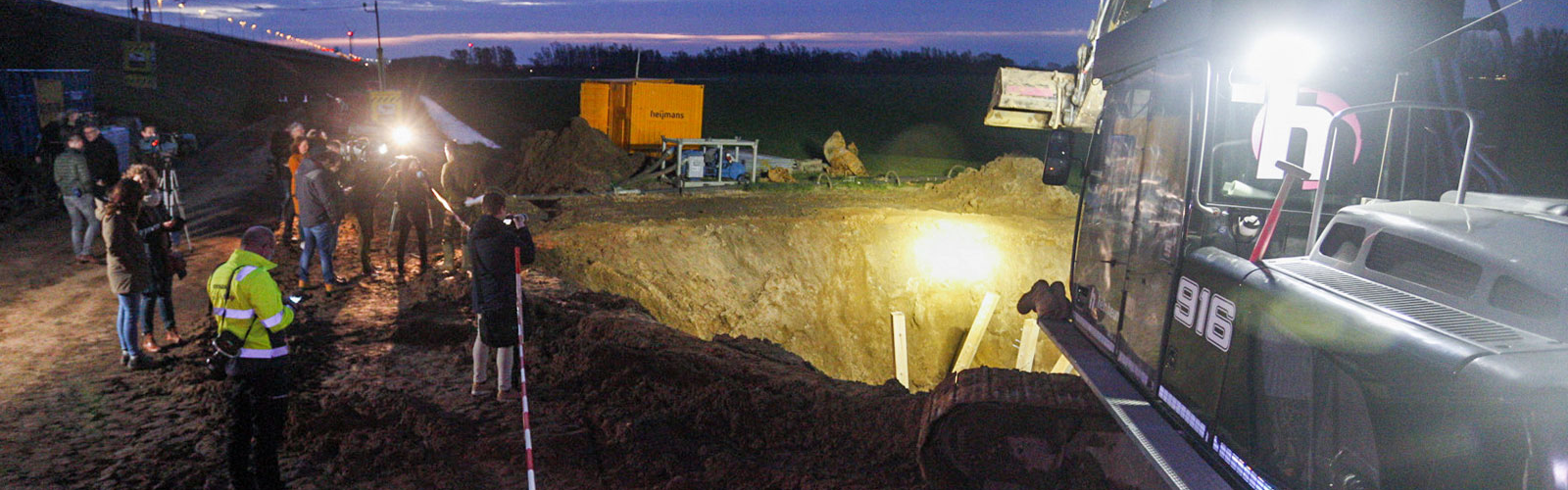
If a suspicious object emerges through an explosives investigation, Hein Heun can approach the possible explosive. In this way the suspicious objects are uncovered, identified and removed. If the approach shows that it concerns an non-exploded explosive, the explosives expert at the location will call in the EOD for this. The explosive is registered by the EOD, made harmless and detonated in a safe location.
Securing area
If no explosive material is detected through the investigation, the area will be released to that depth for further work. This does not mean that explosive material cannot be present below that depth or adjacent to the detected area. It is expected that it will take many decades to get the Dutch soil explosive-free, if it ever succeeds.


